Townsite & Enterprise
Townsite & Enterprise
Townsite & Enterprise
A pharmacist couple, a five-term mayor, and the ostrich feathers that went to the Chicago World's Fair.
G
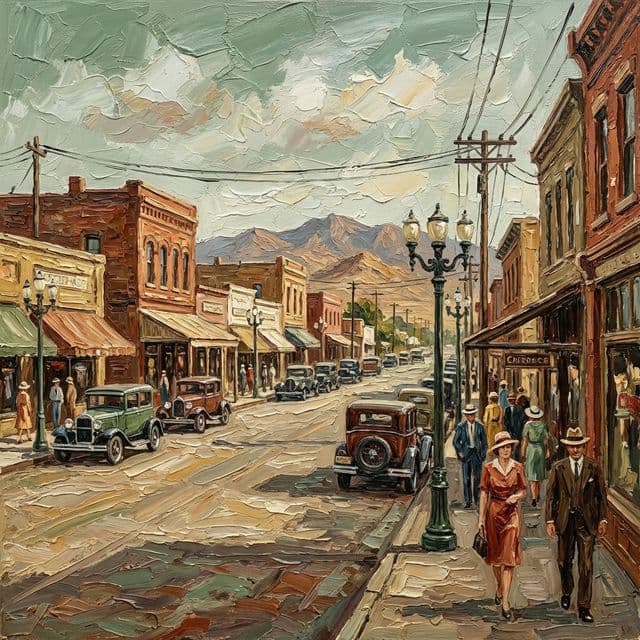
eorge Nicholas Goodman was not the first of his family in Arizona (his grandfather William had died of tuberculosis near St. David in 1885) but he was the one who turned frontier survival into civic architecture. Born in St. David in 1895, George grew up in the Gila Valley before marrying Clara Platt in 1916 and leaving for Los Angeles, where both earned pharmacy degrees. [S12]S12 — UnknownSource: S12They returned to Arizona and opened Goodman's Pharmacy on Mesa's Main Street in 1924. The store sold prescriptions, but it also served as a neighborhood clearinghouse, the kind of place where you learned who was sick, who was building, who had just arrived.
[S12]S12 — UnknownSource: S12Profiles: Great-Grandpa Goodman | Clara Platt Goodman
Clara Platt: the woman who kept the engine running
Clara's story is as foundational as her husband's. She grew up in her father's drugstores in Pima, Thatcher, and Safford. Dr. William Erastus Platt was a physician known as the "Healer of the West." In an era when women rarely pursued scientific professions, Clara earned a full pharmacy degree alongside George in Los Angeles.
[S12]S12 — UnknownSource: S12 [S30]S30 — UnknownSource: S30What made Clara essential went beyond the counter. George was insulin-dependent diabetic, a complex, precarious condition before modern monitoring. Clara, a trained pharmacist, understood the pharmacology, the dosing, the dietary balancing acts. In a very real sense, George's sixteen years of public service were made possible by his wife's medical stewardship.
[S12]S12 — UnknownSource: S12Through the Platt side, Clara also connected the family to national political history: her mother, Isabell Hill Romney, was the full sister of Gaskell Romney, making Clara a first cousin to Governor George W. Romney and a first cousin once removed to Senator Mitt Romney.
[S33]S33 — UnknownSource: S33 [S37]S37 — UnknownSource: S37The mayor behind the counter
Goodman spent sixteen years on the Mesa City Council, ten of them as five-term mayor. Across the 1930s, 1940s, and 1950s, he guided Mesa through utility upgrades and civic modernization. He later served as president of the Arizona Pharmacy Association and the Arizona Municipal League. At his death in 1959, he held the title of Executive Secretary of the Arizona State Fair Commission.
[S12]S12 — UnknownSource: S12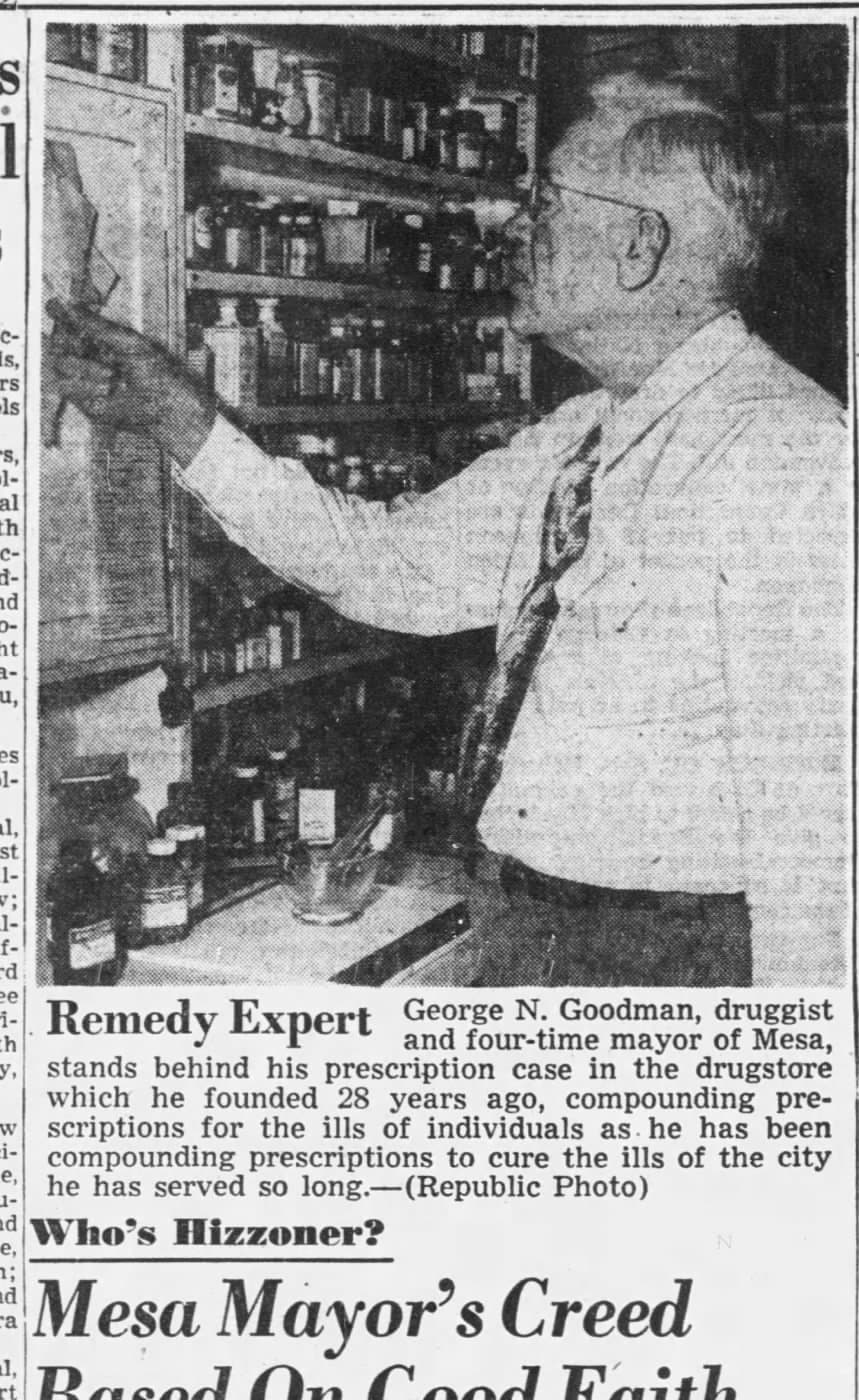
A town takes shape
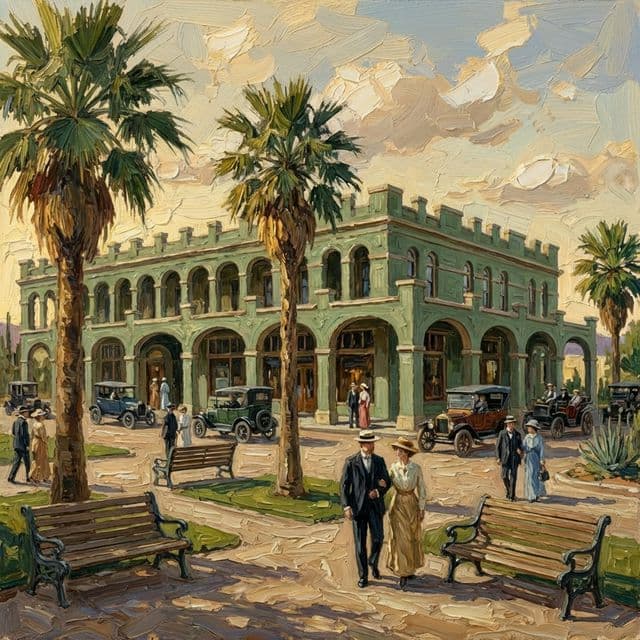
Agriculture powered the East Valley economy in those years. Chandler raised cotton, grains, alfalfa, and even ostriches, whose feathers were prized for fashionable hats in New York and Europe.
[S13]S13 — UnknownSource: S13
The Ellsworth enterprise
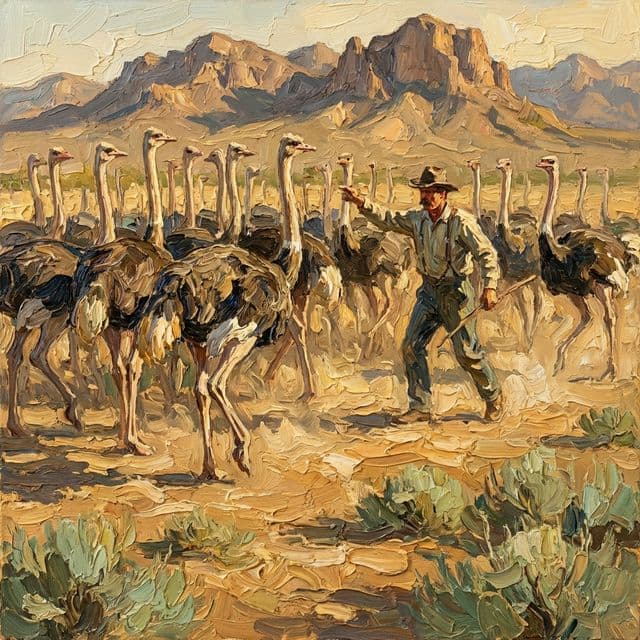
While the Goodmans built pharmacies, another family was building something stranger: an ostrich empire. The Ellsworth family ran one of the East Valley's early ostrich operations, a large ranch with hundreds of birds, their plumes destined for the millinery trade. Louis Ellsworth was among Arizona's first cotton producers, but it was his ostriches that reached the widest audience, exhibited at the Chicago World's Fair as proof of what the desert could produce.
[S2]S2 — Archived WebsiteWikipedia: Falcon Field (Arizona) (Archived)Profile: The Ellsworth Family
Earl Ellsworth, born in Mesa in 1903, married Leona Dana in 1922. Their daughter, Earlene Ellsworth, grew up in this world of farms and civic pride. In 1940, Earlene married Clifford J. Goodman Sr., the son of George and Clara, blending the Goodman and Ellsworth lines into one family and setting the stage for the next chapter's medical legacy.
[S2]S2 — Archived WebsiteWikipedia: Falcon Field (Arizona) (Archived) [S12]S12 — UnknownSource: S12