Sledding on Tunlaw Road
When Washington snow hit hard enough, the D.C. Police barricaded the street and the whole neighborhood came out for barrel fires, sled runs, and a block party in the dark.
During the late 1940s, while Great-Grandpa Clifford was in medical school, the family lived in a government housing project on Tunlaw Road in Northwest Washington, D.C. The house sat at the top of a hill that led down to Stoddart School. Dad recalled the shortcut to school: you could "cut across a small wood (probably just a vacant lot, but it seemed like a forest to me)" along "a well-worn path, lots of squirrels, and, in the fall, lots of acorns".
In winter, snow transformed the neighborhood. The street outside the house ran down a steep hill. "It seemed to me at the time to be an enormously long, fantastically steep street," Dad wrote, "but I have been back as an adult, and it is, of course, neither".
When the snow was deep enough, something magical happened. "The D.C. Police would barricade both ends of the street and it would become a playground for kids with sleds," Dad remembered. "Somebody (I somehow always assumed also the police or the street department) would set up big steel drums with fires in them, where one could warm one's hands between the mad dashes down and desperate efforts to struggle back up the hill".
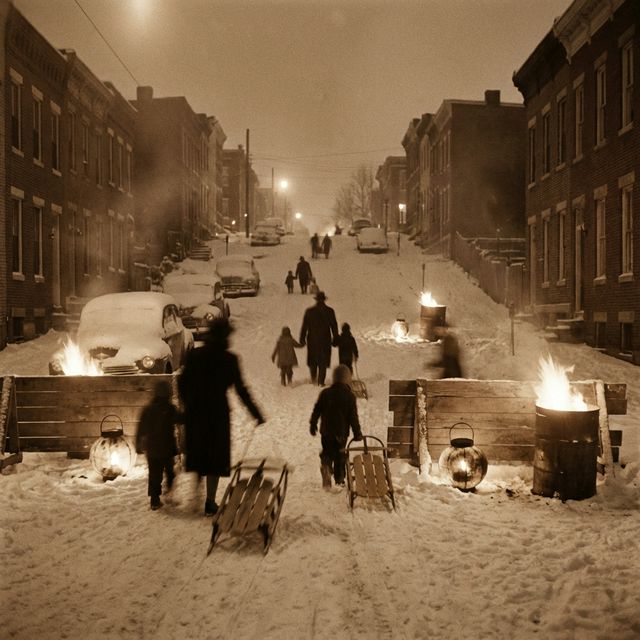
The best nights were when the fires and lanterns stayed lit after dark. "Sometimes the drums were even burning at night, along with those smoky little black, spherical lanterns so common in those days at construction sites, and the whole neighborhood would turn out to sled and make a lot of happy noise". Dad saw it clearly for what it was: "That was the 1940's version of the block party". He added, with a child's logic, "I suppose that they blocked the street because it was steep and slippery, and therefore, dangerous when covered with snow, but we convinced ourselves that the people from the city did it just for us".
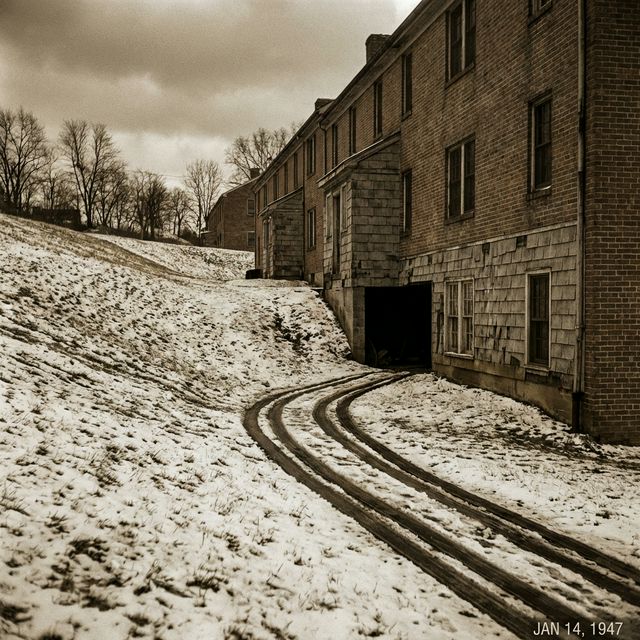
There was also a grassy hill behind the house that served as the year-round sledding alternative. It "seemed like a huge mountain to me then, although, when visited as an adult, it did not look like much at all". One day on that back hill, the sledding took a dangerous turn. Dad's little sister Pamela, "at the time not older than three or four, went down the hill on a sled, quite out of control, ran through the asbestos shingle siding that skirted one building, and vanished into the crawl space under the house". Great-Grandpa Clifford "dragged her out rather quickly," but the event clearly stuck. Dad, who had been the one to push his "protesting, screaming sister off the top of the hill," admitted the crash "really made an impression on the five-year-old". He added, with characteristic honesty, "I am not really sure that it changed his behavior very much, though".
Cast of Characters
Context for this story
Read more in Chapter 3 →Comments
Loading comments...