Global Paths & Homecoming

Global Paths & Homecoming
Global Paths & Homecoming
A missionary from Arizona knocks on a door in Hamburg. Behind it: three generations of Viennese scholarship, a father who served in the Wehrmacht, and the woman he will marry.
The Washington coincidence
B
efore the story reaches Hamburg, it passes through an improbable near-miss in Washington, D.C.In 1943, Clifford Goodman Jr. was born in D.C. while his father attended medical school at George Washington University. The family lived in a government housing project on Tunlaw Road in Northwest Washington, a neighborhood of brick schools, steep hills, and wartime rationing. By 1951, the Goodmans returned to Arizona.
[S35]S35 — Family NarrativeFamily narrative draft: Dr. Clifford J. Goodman Jr. (2026-01-18)Meanwhile, in 1949, a Viennese psychologist named Peter R. Hofstätter emigrated to the United States to teach at MIT and the Catholic University of America, bringing his young family to Washington. His daughter Nadina, born in 1947, was a toddler living just miles from the boy she would eventually marry.
For a brief window between 1949 and 1951, the boy from the Arizona desert and the girl from Vienna were children in the same American capital. They would have to travel thousands of miles and wait over a decade to actually meet.
[GED]GED — Genealogy DatabaseGEDCOM Master File: William Erastus PlattA missionary in Cold War Hamburg
In 1963, duty and faith took Cliff Jr. abroad as a missionary for The Church of Jesus Christ of Latter-day Saints. He was twenty years old, the eldest of eight siblings, and two years past the death of a father he was still processing.
[S35]S35 — Family NarrativeFamily narrative draft: Dr. Clifford J. Goodman Jr. (2026-01-18)The Germany he entered was a complex place. The Berlin Wall had gone up in August 1961, dividing the country along the fault line of the Cold War. The Wirtschaftswunder (economic miracle) was transforming the Federal Republic from a war-ravaged landscape into one of the world's wealthiest nations, but the scars were still visible: bombed-out lots, displaced families, a generation of men who had served in the Wehrmacht and now worked in insurance offices and engineering firms. Hamburg, Germany's second-largest city and its media capital, was a port town with a cosmopolitan edge: the Beatles had played the Reeperbahn just two years before the Arizona missionary arrived.

LDS missionary work in 1960s Germany was a particular kind of cultural exchange. American elders in white shirts knocked on doors in working-class neighborhoods, speaking learned German to families who remembered the occupation. For Cliff, the mission deepened his religious conviction and gave him fluency in German, a skill he maintained for life. It also set the stage for the meeting that would define the rest of his story.
[S35]S35 — Family NarrativeFamily narrative draft: Dr. Clifford J. Goodman Jr. (2026-01-18)The Hofstätter household
The household he entered in Hamburg was something else entirely.
Nadina's father, Peter R. Hofstätter (1913-1994), held the Chair of Psychology at the University of Hamburg, a position he occupied for two decades. Peter had grown up in a Gelehrtenhaus (scholar's household) in Vienna. His own father, Dr. Robert Matthias Hofstätter (1883-1970), was a University of Vienna gynecologist who had pioneered pineal gland research under Otto Marburg, survived the Anschluss by staying and ascending, and spent fifty years treating patients with bovine pineal extract under five successive political regimes.
[S36]S36 — DocumentPeter R. Hofstätter biographical research (2026-01-18) [S22]S22 — Family NarrativeRobert Matthias Hofstätter report draft (2026-01-18)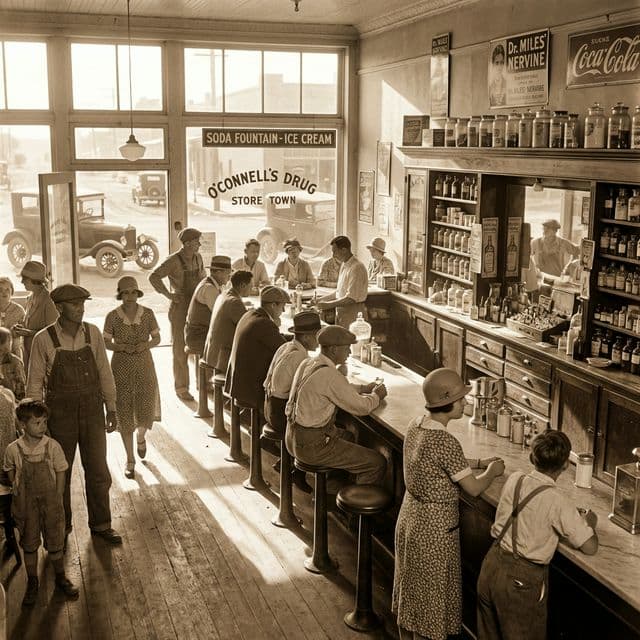
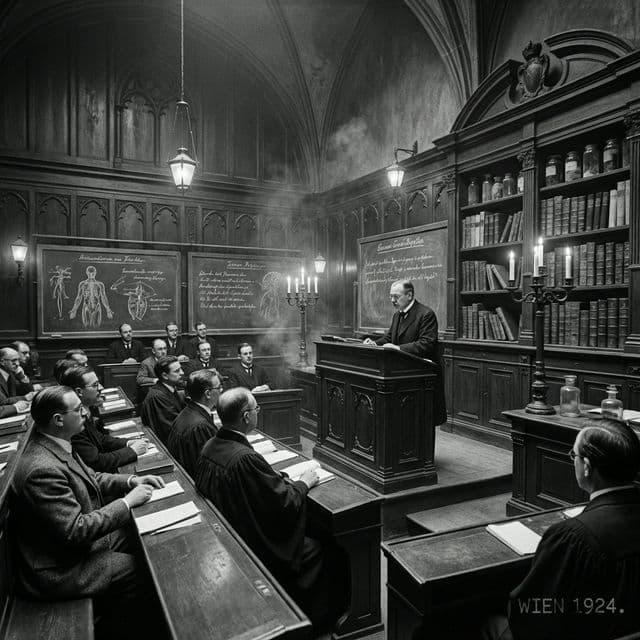
Peter had studied in Vienna under Karl Bühler's circle before the Anschluss scattered his teachers across the globe. He served as a Wehrmacht psychologist during the war, then reinvented himself as an American-trained empiricist at MIT and Catholic University before returning to Germany in 1956. His 1957 Fischer-Lexikon Psychologie sold over 600,000 copies, becoming the standard German reference for the field. His work on group dynamics, public opinion, and the social psychology of postwar amnesty made him one of the most influential (and controversial) psychologists in the Federal Republic. His clash with Theodor Adorno and the Frankfurt School over the question of German collective guilt placed him at the center of the country's most volatile intellectual debate.
[S36]S36 — DocumentPeter R. Hofstätter biographical research (2026-01-18)This was a household where scholarly achievement was the baseline expectation. For Cliff, the Arizona missionary raised on pharmacy counters and school board meetings, the encounter with the Hofstätter world was a collision of civilizations: frontier pragmatism meeting Viennese intellectualism, Mormon faith meeting postwar European skepticism, a stethoscope meeting a bibliothek.
Two worlds meet
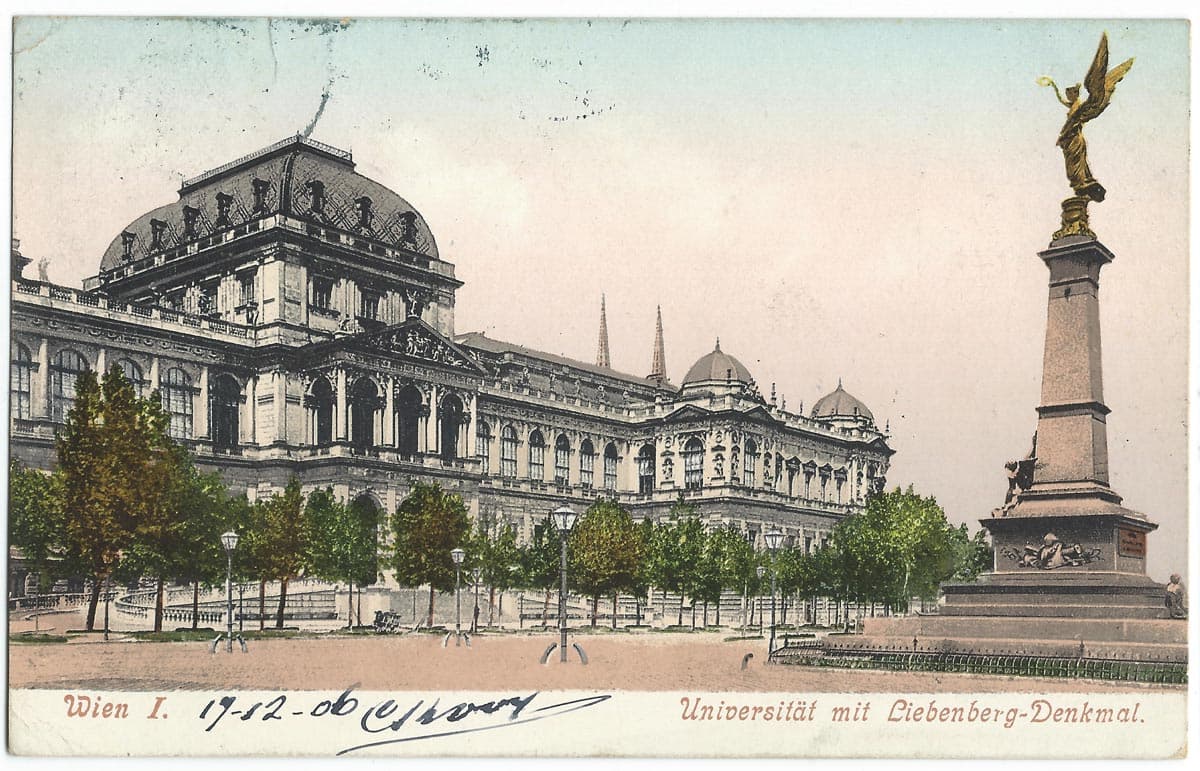
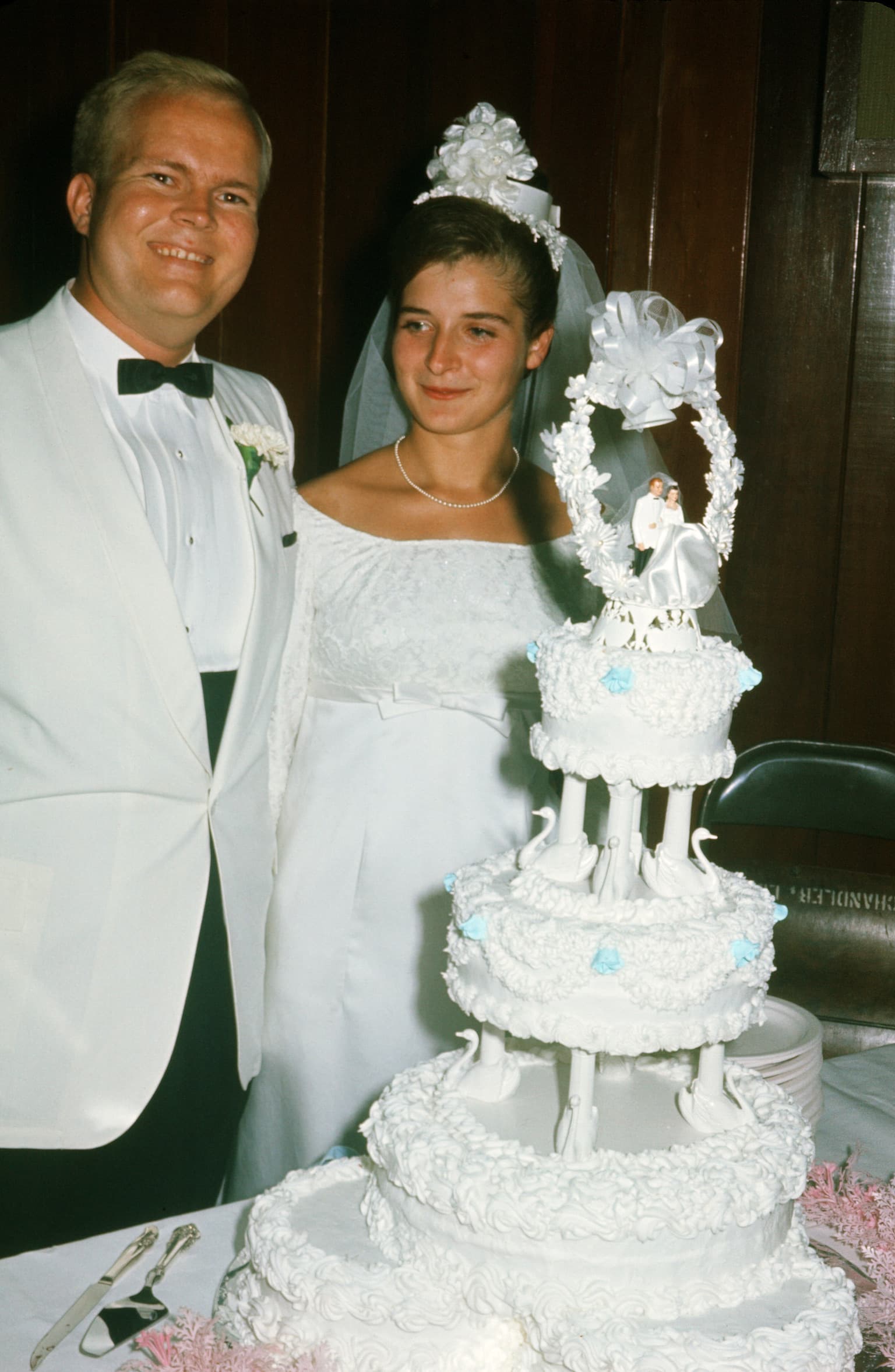
Nadina was drawn to Cliff's warmth and sense of purpose. He was captivated by her intelligence and poise. Defying the distance and the differences between them, Nadina Hofstätter immigrated to the United States at age nineteen. Clifford and Nadina married in Arizona in August 1966.
[S35]S35 — Family NarrativeFamily narrative draft: Dr. Clifford J. Goodman Jr. (2026-01-18)It was a union that braided Arizona's pioneer medical tradition (William's adobe homestead, George's pharmacy counter, Clifford Sr.'s hospital campaign) with Vienna's intellectual legacy: Robert Matthias's endocrine research, Peter's transatlantic academic career, and a family culture in which a doctorate was a coming-of-age rite rather than an aspiration.
Profiles: Dr. Clifford Goodman Jr. | Dr. Peter R. Hofstätter | Dr. Robert Matthias Hofstätter
Twenty-three years
Nadina married a Latter-day Saint but did not join his church. For twenty-three years she attended services, organized Relief Society homemaking events, drove children to every ward activity, and raised six children in an LDS household without being a baptized member herself. It was a long, quiet negotiation between two traditions and two temperaments.
On New Year's Day 1989, Clifford recorded the news he had been waiting years to write: "Dina announced to us Friday night that she was ready to be baptized." She was baptized on January 7, 1989. Later that year, the family was sealed in the Mesa Arizona Temple.
[S4]S4 — UnknownSource: S4Her sister Nori joined the Church in Germany years later, after being taught by family friends in Chandler. That conversion, too, traced back to Nadina's quiet, central influence.
Stories: Dina's Baptism | The Temple Sealing
Coming home
They returned to Chandler in 1976. Cliff opened an OB/GYN practice that grew into the MomDoc group, serving thousands of East Valley families. He served as Chief of Staff at Chandler Regional Medical Center and helped guide the hospital through its 1980s relocation to the current campus, extending, by another generation, the family's entanglement with the town's healthcare infrastructure.
[S35]S35 — Family NarrativeFamily narrative draft: Dr. Clifford J. Goodman Jr. (2026-01-18) [S10]S10 — News ArticleChamber Business News: MomDoc (Archived) [S29]S29 — UnknownSource: S29In 1986, the family moved to a home on North Bullmoose Drive, a dirt road at the time in a semi-rural "horse neighborhood" on the outskirts of town. The property was dotted with split-rail pasture fences, grazing quarter horses, and the occasional rooster crowing at dawn. On a generous 0.8-acre lot, the six children (Clifford III, Peter, Nick, Matthias, Michael, and Dana) roamed freely on bikes, cut through alfalfa fields and pecan groves that smelled of damp earth after irrigation, raced dirt bikes along the concrete canals, and played street hockey undisturbed for hours. It was the raw, unstructured childhood of 1980s Arizona, overseen by a mother who somehow kept the chaos contained.
[S4]S4 — UnknownSource: S4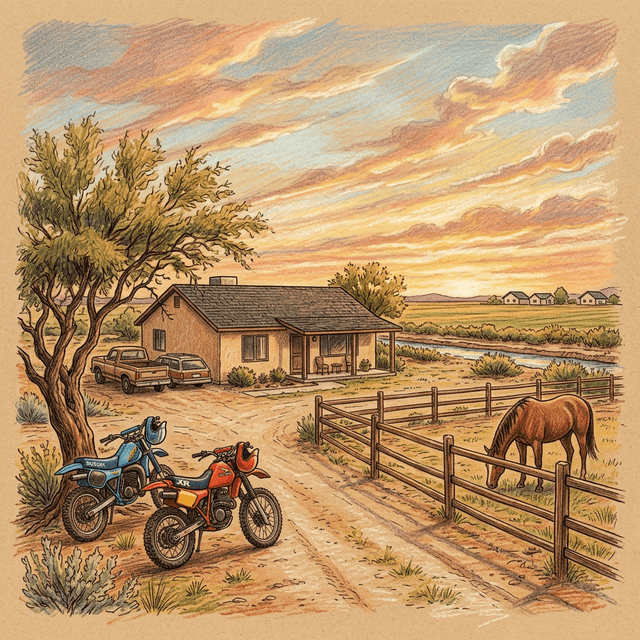
"Today was the annual family gathering ... to celebrate Grandma's birthday."
Chandler grew from about 30,000 in 1980 to over 100,000 by 2000 as Intel built nearby and master-planned subdivisions replaced the cotton fields. The dirt roads were paved. The vacant lot was bulldozed for a grocery store. But the family held onto pieces of the old ways: annual camping trips to the mountains, the irrigation ditch that still ran behind the property, and the friendships forged in that Bullmoose Drive neighborhood. Around the dinner table, the children heard a mix of Chandler news and Viennese history, medical shop talk and the German phrases their mother never dropped. The transatlantic thread does not end with immigration. It persists in every German Christmas tradition, every Austrian recipe, every bilingual bedtime story, and every grandchild who hears the word Oma before "Grandma."
[S4]S4 — UnknownSource: S4| Year | Event |
|---|---|
| 1913 | Peter R. Hofstätter born in Vienna |
| 1943 | Clifford Goodman Jr. born in Washington, D.C. |
| 1947 | Nadina Hofstätter born in Austria |
| 1949 | Peter moves to MIT/D.C.; Nadina and Cliff are children in the same city |
| 1959 | Peter takes Chair of Psychology at University of Hamburg |
| 1963 | Cliff begins LDS mission in Germany |
| 1966 | Clifford and Nadina marry in Arizona |
| 1976 | They return to Chandler; Cliff opens OB/GYN practice |
| 1986 | Family moves to Bullmoose Drive |
| 1989 | Nadina baptized; family sealed in Mesa Arizona Temple |
| 1994 | Peter R. Hofstätter dies in Buxtehude, Germany |