How to Interview Your Family
A guide to contributing to the family archive, from simply recording a rough voice memo, to a comprehensive playbook for conducting formal oral history interviews.
The stories in this archive exist because someone made time to ask, and to listen. Journals helped. Genealogy records helped. But the material that brought these pages to life came from conversations: a grandfather describing a freight wagon, a mother explaining why she left Vienna, a cousin remembering the smell of the pharmacy counter.
It is important to be honest about how the polished narratives on this site come together. I have collected decades of raw material: handwritten journals, news clippings, unsorted letters, and rough, informal audio recordings. To organize this overwhelming volume of information, I use artificial intelligence. We embrace AI as an archival tool to parse, structure, and synthesize these fragmented pieces. It can seamlessly cross-reference a five-minute rambled voice memo with dates from a genealogy record and context from a journal entry, allowing me to weave them into the complete narratives you read here.
For our family: The zero-barrier contribution
Because we use this technology, the barrier to contributing to this archive is zero. If you are a member of our family, you do not need to conduct a formal interview. If you remember something about a grandparent on your drive to work, or find an old letter in a box, just open the Voice Memos app on your phone, record your thoughts, and send it to me.
Your recording can be rough as hell. You don't need a quiet room, and you don't need perfect questions. Don't worry about being articulate or getting every date right. Just send the raw memory. The system helps organize it, I edit and publish it, and the story lives on.
For everyone: The formal interview guide
However, there is still profound value in sitting down to formally record someone's life story. The absolute richest material I work with always comes from these dedicated, quiet moments.
Whether you are interviewing an elder in our family, or you landed on this site looking for ways to record your own relatives, the rest of this guide is for you. What follows is the exact playbook I use, drawn from professional oral historians and cognitive psychology. You don't need special training. You just need a quiet room, a recording device, and someone willing to talk.
1. Before you sit down
The quality of a family interview depends almost entirely on what happens before the recorder starts. Professional oral historians spend as much time preparing as they do interviewing. For a family conversation, even thirty minutes of focused preparation will transform the result.
Choose the right person and timing
Not every family member is ready to be interviewed at any given moment. Look for these conditions:
- Willingness. The person should want to talk. A reluctant subject produces guarded, thin answers. If someone declines, respect that. Ask again in six months.
- Energy. Schedule the interview when the person is most alert. For elderly relatives, this is usually mid-morning. Avoid post-meal drowsiness. Avoid holidays, when the house is chaotic.
- Privacy. One-on-one interviews produce better material than group conversations. When multiple people are present, they correct, interrupt, and edit each other. The goal is one person's unfiltered memory.
Do your homework
Before the interview, gather what you already know about the person's life. Review:
- Family records. Birth dates, marriage dates, places of residence. You want these facts in front of you so you can use them as launching pads ("You moved to Mesa in 1951. What was that like?") rather than wasting interview time collecting them.
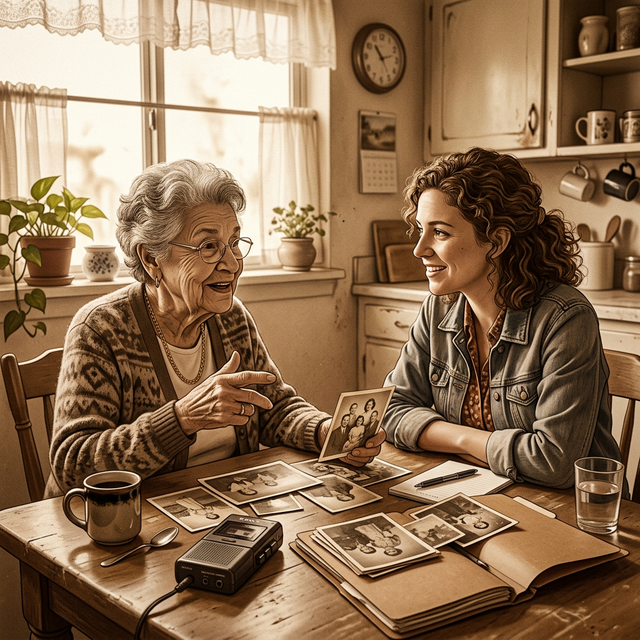
- Photographs. Bring a folder of old family photos. Photos are the single most effective memory trigger. When a person holds a photograph, they do not describe what they see. They describe what they remember. The image activates entire episodes: who was there, what the room smelled like, what happened just before the shutter clicked.
- Documents and artifacts. Report cards, newspaper clippings, letters, recipes, military records. Physical objects anchor memory to specific moments.
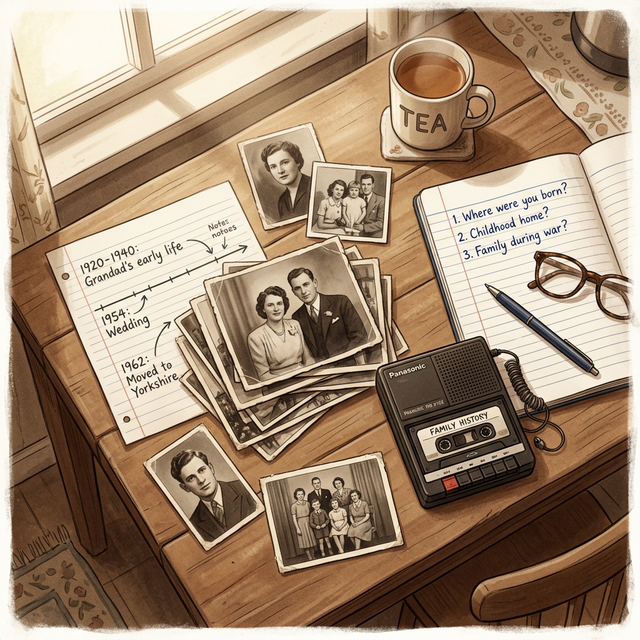
- A rough timeline. Write out a simple chronology of the person's life on a single page: childhood, school, marriage, career, children, moves, losses. This is your roadmap during the conversation.
Prepare your questions (loosely)
Write out 15-20 questions in advance. Do not memorize them. Do not read them off a sheet like a survey. The list is a safety net for when the conversation stalls. The best material will come from follow-up questions you invent in the moment, responding to something the person just said.
Organize your questions roughly by life stage (childhood, young adulthood, family, career, reflection) so the conversation moves forward through time. People remember more accurately when they narrate chronologically, because each memory cues the next.
2. Setup and Conversation
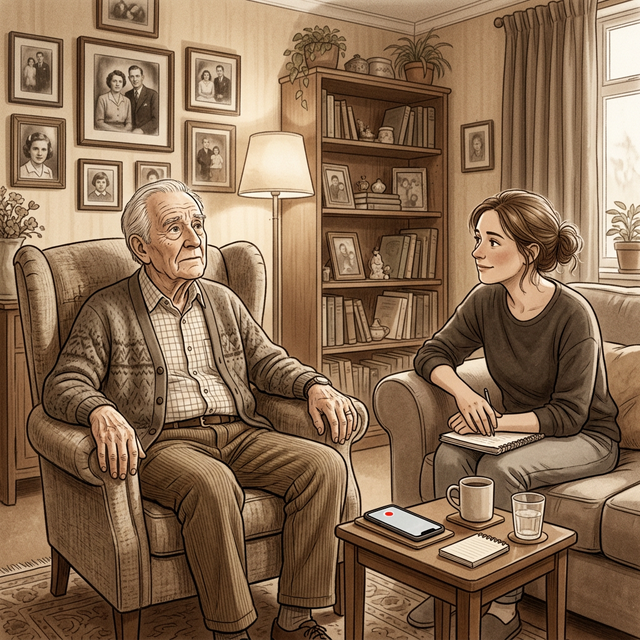
A smartphone is all the equipment you need. Open the Voice Memos app (iPhone) or Voice Recorder (Android). Set the phone face-up on a hard surface between you.
Before you press record, spend a few minutes talking casually to establish the cadence of a normal conversation. Once the recorder is going, standard practice is to announce the date, your name, their name, and the location. It makes the file instantly recognizable for decades to come.
Listen more than you talk
The most common mistake in family interviews is talking too much. Your job is to create space for the other person to remember aloud. The ideal ratio is 80/20: they talk 80% of the time. You talk 20%.
Practical habits:
- Nod instead of speaking. When someone tells you something interesting, your instinct is to say "That's amazing!" or "I had no idea!" Resist. Nod, maintain eye contact, and stay quiet. Verbal interjections break the person's train of thought.
- Let silences hang. When a person pauses, wait. Count to five in your head. They are retrieving a memory. If you jump in with the next question, you abort the retrieval. Some of the most vivid material comes after a long pause.
- Never correct. If they get a date wrong or confuse two names, do not correct them during the recording. Note it for yourself and verify later. Correction makes people self-conscious.
The follow-up prompts
The questions you prepare in advance are just conversation starters. The real material comes from follow-up prompts. Keep these phrases ready:
| Prompt | What it does |
|---|---|
| "Tell me more about that." | Opens a thread the person started but left short. |
| "What happened next?" | Moves the narrative forward in time. |
| "What did that feel like?" | Shifts from facts to emotion. |
| "Can you describe the room?" | Activates sensory memory (sight, sound, smell). |
| "What did [person] say?" | Recovers direct dialogue, the most vivid form of storytelling. |
3. The questions
Do not treat this like a survey. Pick a few broad themes that feel right for the specific person you are interviewing, and let the conversation flow naturally from there. Plan for an hour or so. If they want to keep talking, keep going, but don't force a marathon.
Childhood & Formation▼
- What is your earliest memory?
- Walk me through the rooms of the house you grew up in. What did it smell like?
- Tell me about your parents. What were they like on an ordinary day?
- What was the first piece of technology you remember being amazed by?
- Was there a teacher, a book, or an event that shifted the direction of your life?
Life & Love▼
- How did you meet your partner? Tell me the whole story, from the first moment.
- Were you ever scared to be a parent? What scared you?
- How did you choose your career? Was it a choice, or did it choose you?
- What was the hardest thing about your work that outsiders would never guess?
Trials & Beliefs▼
- What was the most difficult period of your life? What got you through it?
- What role did faith, church, or community play in your family's life?
- Is there something you believed deeply when you were young that you no longer believe?
- What historical event do you remember most vividly? Where were you?
Legacy▼
- What are three events that shaped who you are more than any others?
- What's something you accomplished that you're genuinely proud of?
- If you could have a conversation with your 20-year-old self, what would you say?
- What do you want your great-grandchildren to know about you?
4. After the interview
The audio file you just created is a family heirloom. Treat it like one.
- Back it up immediately. Email a copy to yourself, or upload it to a cloud drive like Google Drive or iCloud so it isn't lost if you drop your phone.
- Contact the Archive. If you are a member of our family, email the audio file directly to me. I will use AI to transcribe it, pull out the history, integrate it into the timeline, and publish the stories right here.
- Save it to FamilySearch. If you aren't part of our direct family, upload your recording directly to FamilySearch.org as a "Memory" attached to the person's record. They preserve these histories for free, tying the audio directly to your family tree for future generations to find.
5. Why this matters
This archive was built from journals, letters, historical records, and the memories of people who are no longer here. Every unrecorded conversation is a permanent loss. Every recorded one is a gift to every generation that follows.
If someone in your family is still here to answer these questions, the time to ask is now. Pick up your phone. Ask a question. Start recording.